From mg/mL Stock to nM in Media: Worked Dilution Examples for Cell Culture
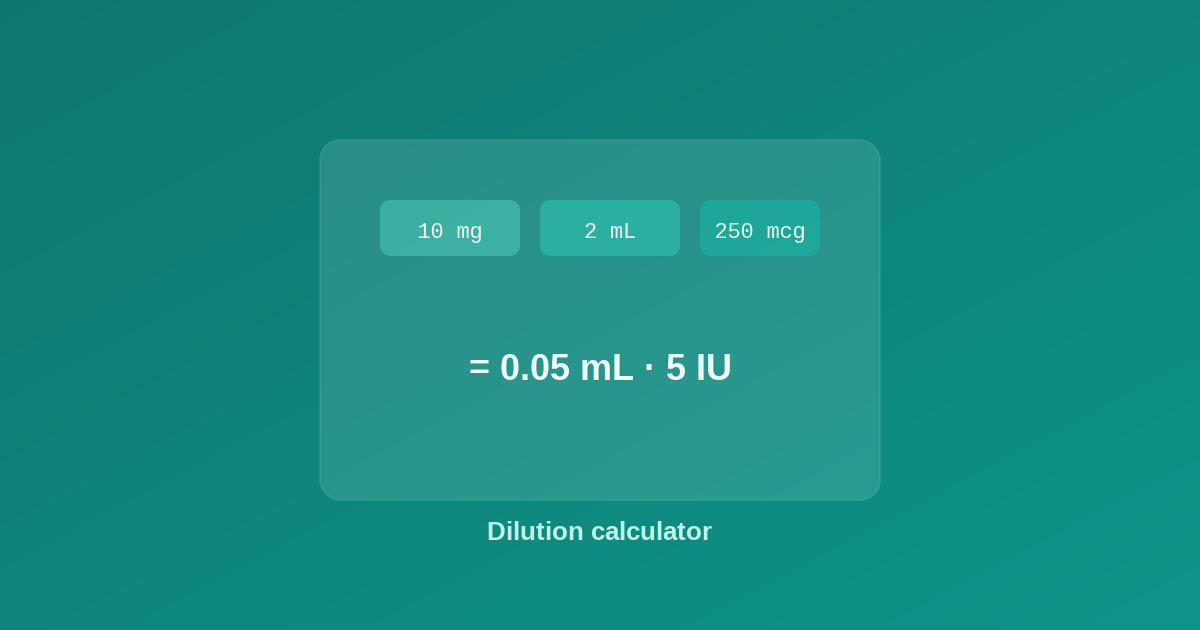
Three bench calculations — MOTS-c, Semax, and NAD+ — from labelled milligrams to nanomolar or micromolar medium, using micropipettes, not injection syringes.
Research use only
Peptides X10 supplies materials strictly for in vitro laboratory research. The calculations below are for cell-culture micropipetting by trained personnel. They are not injection instructions, clinical dosing, or guidance for human or veterinary use.
The Peptides X10 calculator at /tools/calculator converts labelled vial mass and diluent volume into a stock concentration, then into a transfer volume. This post does not re-explain how to wet a lyophilised cake or how to read a Janoshik chromatogram — those are /blog/reconstitution-workflow-best-practices and /blog/reading-peptide-coas-janoshik. It walks three laboratory examples from mg/mL stock to a concentration in culture medium, using P20/P200/P1000 pipettes. Insulin-syringe “units” do not appear. Nothing here is an injection protocol.
Two corrections belong in every example before the first microlitre. First, net peptide content (NPC) and salt form: a 5 mg acetate or TFA salt is not 5 mg of free peptide. Use the Janoshik NPC (or the stated formula weight for NAD+) so the molarity is peptide or coenzyme, not counter-ion. Second, pipette into the accurate range of the tip — generally the middle of the barrel, not 0.2 µL on a P20. If the direct transfer is below ~2 µL, insert an intermediate dilution. That is cell-culture practice, not a workaround.
Example 1 — MOTS-c 10 mg to 100 nM in a 2 mL Seahorse well volume
Assume the Janoshik COA NPC is high enough that you treat the label as 10.0 mg peptide (if NPC is 82 percent, use 8.2 mg and repeat the same steps). MOTS-c MW ≈ 2,175 g/mol. Reconstitute the 10 mg vial in 2.00 mL sterile diluent. Stock = 5.00 mg/mL. Molarity = (5.00 g/L) / 2,175 g/mol = 2.30 × 10⁻³ mol/L = 2.30 mM.
Target: 100 nM MOTS-c in 2.00 mL XF assay medium. Required peptide = 2.00 × 10⁻³ L × 100 × 10⁻⁹ mol/L = 2.00 × 10⁻¹⁰ mol. Direct volume of 2.30 mM stock = 2.00 × 10⁻¹⁰ / 2.30 × 10⁻³ = 8.7 × 10⁻⁸ L = 0.087 µL. That volume is not pipettable. Make a 10 µM intermediate: 10.0 µL of 2.30 mM stock into 2.29 mL medium (total 2.30 mL) gives 10.0 µM. Then add 20.0 µL of the 10 µM intermediate to 1.98 mL medium (total 2.00 mL) to reach 100 nM. Record both steps. A 20 mg or 40 mg vial uses the same ladder after you recompute the stock millimolarity.
Example 2 — Semax 5 mg to 10 nM in 500 µL SH-SY5Y medium
Semax MW ≈ 814 g/mol. Reconstitute 5.00 mg (again, scale by NPC) in 2.50 mL diluent. Stock = 2.00 mg/mL = 2.00 g/L / 814 g/mol = 2.46 mM. Target: 10 nM in 500 µL. Required peptide = 5.00 × 10⁻⁴ L × 10 × 10⁻⁹ mol/L = 5.00 × 10⁻¹² mol. Direct stock volume = 5.00 × 10⁻¹² / 2.46 × 10⁻³ = 2.0 × 10⁻⁹ L = 0.002 µL. Impossible in one step.
First intermediate: 10.0 µL of 2.46 mM stock into 9.99 mL medium → 2.46 µM (1,000-fold). Second step: 10.0 µL of 2.46 µM into 2.45 mL medium → 10.0 nM working medium (246-fold). Replace or add that 10 nM medium onto the SH-SY5Y well as the protocol specifies — for a 500 µL well, pipette 500 µL of the 10 nM working medium, not 500 µL of stock. Selank at ~752 g/mol uses the same two-step pattern; do not reuse Semax volumes and pretend the molarity matches. Combination plates need a 10× Semax intermediate and a 10× Selank intermediate combined in the well, not one blended frozen stock.
Example 3 — NAD+ 100 mg to 500 µM in 10 mL medium
NAD+ is not a peptide. MW ≈ 663 g/mol. To make a 100 mM stock from a 100 mg vial: moles = 0.100 g / 663 g/mol = 1.51 × 10⁻⁴ mol; volume = 1.51 × 10⁻⁴ / 0.100 = 1.51 × 10⁻³ L = 1.51 mL diluent. Stock ≈ 66.3 mg/mL = 100 mM. Target: 500 µM in 10.0 mL. Volume of 100 mM stock = (500 × 10⁻⁶ / 100 × 10⁻³) × 10.0 mL = 0.050 mL = 50 µL. Add 50 µL to 9.95 mL medium. A P200 handles 50 µL cleanly. A 500 mg vial needs 7.54 mL for the same 100 mM stock; a 1000 mg vial needs 15.1 mL. Wrap the stock — NAD+ is photolabile; see /blog/nad-plus-cell-culture-reconstitution.
What the calculator should be asked
- Stock mg/mL from labelled (or NPC-adjusted) milligrams and diluent millilitres
- Stock millimolarity from mg/mL and molecular weight
- Intermediate volume when the direct transfer is below ~2 µL
- Final spike volume into a stated well or dish volume
Net peptide content and salt form — the silent ten-percent error
Research peptides in this catalogue are typically acetate or trifluoroacetate salts. The vial label is a nominal fill. The Janoshik COA states NPC and, when listed, salt form. Planning molarity on the nominal milligrams without NPC systematically overstates peptide in the well. Whether your SOP multiplies mass by NPC, or treats a high-purity lot as label mass and documents that choice, pick one rule and print it on the aliquot. Purity percent is not the same number as NPC: HPLC area-percent is a chromatogram; NPC is how much peptide is in the powder. Do not multiply both unless the SOP says so and you understand why.
NAD+ uses formula weight and assay purity, not peptide NPC. Mixing the two conventions on one spreadsheet is how a 100 mM coenzyme stock and a 2 mM peptide stock get swapped in a shared “stocks” box. Separate sheets, separate tube colours.
Micropipettes, not syringes
Cell-culture dilution is a micropipette problem: air-displacement pipettes, filtered tips if the SOP requires them, reverse pipetting for viscous or low-volume intermediates, and a new tip when you change concentration decade. Do not convert these volumes into insulin-syringe units. Syringe-unit markings exist for clinical insulin delivery. They are the wrong mental model for a 20 µL transfer into a Seahorse well. If a colleague asks for “units,” stop and rewrite the plan in µL and nM. Peptides X10 does not provide injection guidance.
Dead volume in the vial is real. Plan the last aliquot as incomplete, or accept that 50–80 µL of stock stays on the glass. Do not chase it with extra diluent after the concentration has been written on twenty tubes. If you add diluent after the fact, recompute every concentration with the calculator and relabel immediately.
Worked NPC adjustment on the Semax numbers
Suppose the 5 mg Semax label is TFA salt and Janoshik NPC is 80 percent. Peptide mass = 4.00 mg. In 2.50 mL that is 1.60 mg/mL, not 2.00 mg/mL. Molarity = 1.60 / 814 × 1000 = 1.97 mM, not 2.46 mM. Every downstream fold-change in Example 2 scales. The 10 nM well is still 10 nM only if you rebuild the intermediates from 1.97 mM. Teams that “correct later in the paper” never correct the aliquot labels. Do the NPC step on the calculator before reconstitution, then pipette the new volumes.
How this sits next to the other hubs
Reconstitution technique and sterile wetting: /blog/reconstitution-workflow-best-practices. Freezer and lyophilised storage: /blog/lyophilised-peptide-storage-guide. Janoshik fields: /blog/reading-peptide-coas-janoshik. Compound-specific assay notes — MOTS-c respiration, Semax/Selank endpoints, Epitalon markers, NAD+ light SOP — live on those posts, not here. 10-vial pack sizing is /blog/planning-10-vial-kit-lab-orders. Shipments are Priority Tracked Shipping — DHL/UPS, lyophilised ambient, −20 °C on receipt (/blog/worldwide-manufacturer-shipping-labs).
Run the calculator before the stopper is punctured. Write stock mM, intermediate µM, and well nM (or µM for NAD+) in the notebook with lot and NPC. Then pipette those volumes. That is the entire job of a dilution plan: make the arithmetic boring so the assay can be the variable.
Related resources
All content is for in vitro laboratory research context only. Not medical advice.